 Go to the homepage
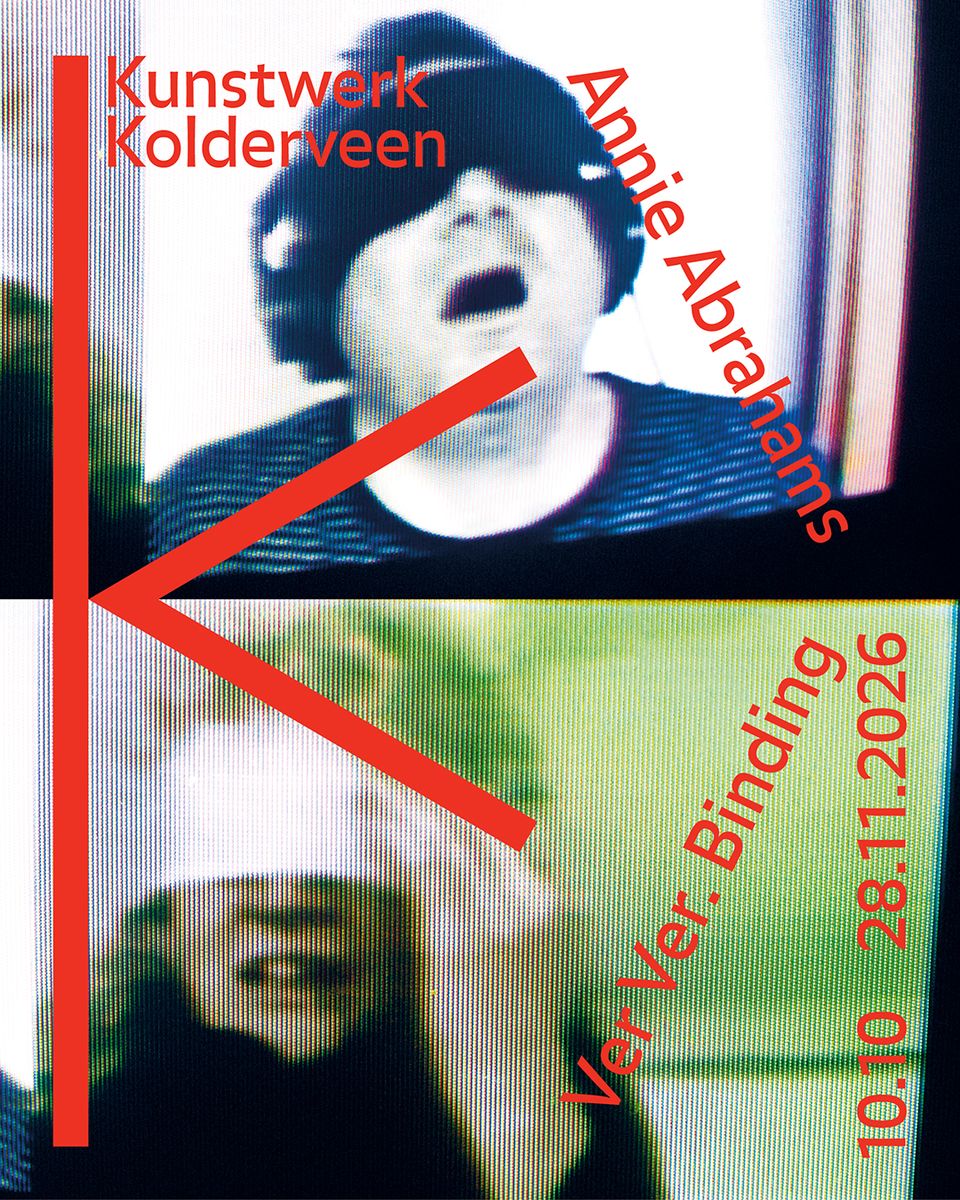
10 October until 28 November
Location: NijeveenKunstwerk Kolderveen is proud to present Ver Ver . Binding, the first retrospective exhibition of Annie Abrahams in the Netherlands. The show will run from the 10th of October till the 28th of November, 2026 and will span over 30 years of the artist’s practice. It brings together artworks, sketches, books, and archival materials.
Since the mid-1990s, Abrahams has been one of the pioneers of internet-based performance, exploring the network as a spatial dimension, where human relations, behaviours, languages, emotions, and vulnerabilities meet and become tangible.
The work of Annie Abrahams has long been concerned with connection (in Dutch, verbinding): how we as human beings relate to each other through languages and bodies, how we connect when we are at a distance, and what kinds of relationships technology may open or limit for us.
In the ar…
Kunstwerk Kolderveen is proud to present Ver Ver . Binding, the first retrospective exhibition of Annie Abrahams in the Netherlands. The show will run from the 10th of October till the 28th of November, 2026 and will span over 30 years of the artist’s practice. It brings together artworks, sketches, books, and archival materials.
Since the mid-1990s, Abrahams has been one of the pioneers of internet-based performance, exploring the network as a spatial dimension, where human relations, behaviours, languages, emotions, and vulnerabilities meet and become tangible.
The work of Annie Abrahams has long been concerned with connection (in Dutch, verbinding): how we as human beings relate to each other through languages and bodies, how we connect when we are at a distance, and what kinds of relationships technology may open or limit for us.
In the artist's networked performances, participants are located in different rooms, cities, or countries. They share the space together on screen, connected through webcams and specially designed (pre-Skype/Zoom era) software, where an unsteady field of intense emotions, interruptions, silences, and fragments emerges. Abrahams has described her practice as developing “an aesthetics of trust and attention,” in which connection emerges through the willingness to remain present with others. Abrahams’ work exposes the fragile space where multiple voices meet, mutually translating and (mis)understanding each other, and where the body becomes a transmitter of emotional states and a tester of boundaries
Since its emergence in the 1990s, the internet has profoundly shaped contemporary lives and social relations. Abrahams’s work artistically investigates this early moment of the technology’s ascent, exposing its double potential to connect and to separate. The internet’s original promises of openness, community, and frictionless communication now appear in a much darker light, with the rise of surveillance regimes, data extraction, echo chambers, and algorithmic manipulation. Abraham’s performances explore on a microscopic level how the then new medium of cyberspace instigated novel possibilities and ambiguities in human connections. The performances develop their own technological and aesthetic tools to experiment with relations in the new technological conditions, from sexuality, personal intimacy, and tactile experiences, to choreographies and coordinated actions over national borders, cultural differences, and linguistic divides.
In the title of the exhibition the repeated Ver (Dutch for ‘far’) emphasizes the distances at play. Binding, on the other hand, means bonding and connection, thus suggesting the bridging of the distance, making the far away close by, while perhaps also intimating the emergence of distances within intimacy. Ver Ver . Binding reflects on the ambiguity of internet relations from their early days, creatively experimenting with technological protocols and digital interfaces, looking for human connection in its most fragile, exposed, and caring forms.
For Kunstwerk Kolderveen this exhibition opens a long-term program exploring living together, migration, and the militarisation of the rural landscape. It originates in a pivotal question: How do technology and community shape one another? Both the internet and the rural landscape are sites of this tension: they promise connection while also producing isolation, invisibility, and longing. Working with an artist based in the rural town just across the provincial border in Overijssel, whose practice has long explored locality, translation, connection, and alienation, the exhibition embraces locality and distance as starting points for connection. Abrahams' way of bringing small groups of strangers to read or move together in the space engages directly with the institution's methodology of working with local stakeholders as active participants. This exhibition's approach to audience engagement is organized as a network of relations, where neighbors are invited to work together and to bring wider circles in as audiences.