 Go to the homepage
Go to the homepage
Go to the homepage
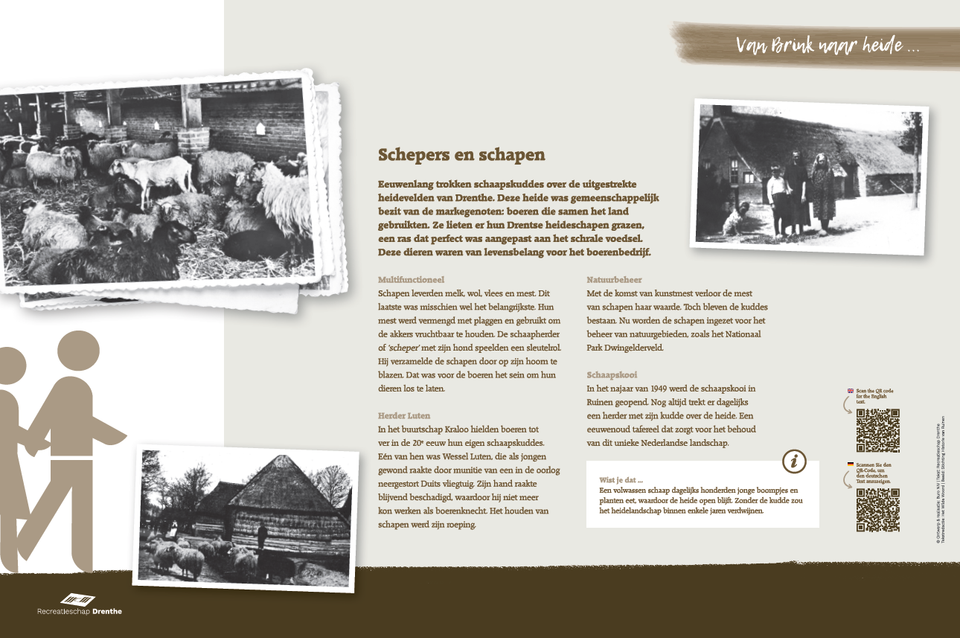
For centuries, flocks of sheep roamed the vast heathlands of Drenthe. The heath was common land owned by the markegenoten: farmers who shared the land. They grazed their Drenthe heath sheep there, a breed perfectly adapted to the sparse food. These animals were vital to farming in the region.
Versatile creatures
Sheep provided milk, wool, meat and manure, the last of which was perhaps the most important. Their manure was mixed with sods and used to keep the arable fields fertile. The shepherd and his dog played a central role in this process. He would gather the flock by blowing his horn, signalling to farmers that it was time to release their sheep.
Sheperd Luten
In the hamlet of Kraloo, f…
For centuries, flocks of sheep roamed the vast heathlands of Drenthe. The heath was common land owned by the markegenoten: farmers who shared the land. They grazed their Drenthe heath sheep there, a breed perfectly adapted to the sparse food. These animals were vital to farming in the region.
Versatile creatures
Sheep provided milk, wool, meat and manure, the last of which was perhaps the most important. Their manure was mixed with sods and used to keep the arable fields fertile. The shepherd and his dog played a central role in this process. He would gather the flock by blowing his horn, signalling to farmers that it was time to release their sheep.
Sheperd Luten
In the hamlet of Kraloo, farmers kept their own flocks well into the 20th century. One of them was Wessel Luten, who had been injured as a boy by ammunition from a German aircraft that had crashed during the war. His hand was permanently damaged, which meant he could no longer work as a farm labourer. Wrangling sheep became his calling.
Nature management
With the introduction of artificial fertiliser, sheep manure lost its importance. The flocks, however, remained. Today the sheep are used to manage nature reserves, including the Dwingelderveld National Park.
Sheepfold
The sheepfold in Ruinen was opened in the autumn of 1949. To this day, a shepherd still leads his flock across the heath each day, a centuries-old sight that helps preserve this distinctive Dutch landscape.
Did you know...
An adult sheep eats hundreds of young saplings and plants every day, keeping the heathland open. Without the flock, the heath would disappear within a few years.